Frequently Asked Questions
The most-asked questions about islands of the pacific.
What exactly do 'Pacific Islands' refer to?
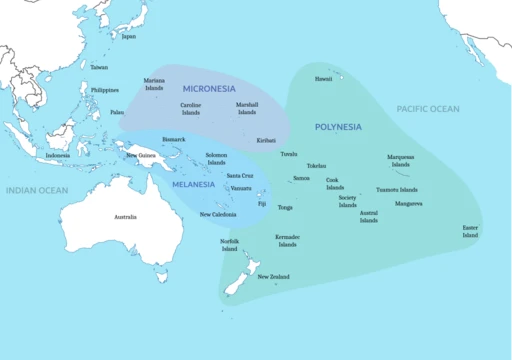
The term covers the roughly 10,000–15,000 islands scattered across the Pacific Ocean, stretching from Polynesia in the east to Melanesia in the southwest and Micronesia in the north. They include both sovereign nations and territories administered by other countries.
How many sovereign Pacific Island nations are there?
There are 14 fully independent countries in the region, including Fiji, Samoa, Tonga, Vanuatu, and Papua New Guinea. Several additional island groups, such as Guam, American Samoa, and New Caledonia, remain external territories of the United States, France, or New Zealand.
What are the three main cultural-geographic groupings?
Scholars divide the islands into Polynesia (Hawaiʻi, New Zealand, Tahiti), Micronesia (Guam, Palau, Marshall Islands), and Melanesia (Papua New Guinea, Solomon Islands, Vanuatu). Each grouping shares broad linguistic and navigational traditions while remaining internally diverse.
Who are some of the most historically significant figures associated with the Pacific Islands?
Pre-colonial wayfinders like the legendary navigator Kupe (in Māori tradition) and the Polynesian star-path navigators shaped the settlement of the ocean. In the modern era, leaders such as Sir John Monasa (Papua New Guinea's first prime minister) and Tu'i Mafile'o (Tonga) played defining roles in independence and self-governance.
Where should a newcomer begin learning about Pacific Island cultures and history?
A good starting point is a regional overview text on Oceanic anthropology or the UNESCO collections on Pacific oral traditions. From there, diving into one specific island nation's history—say, the Polynesian Voyaging Society's accounts or Vanuatu's kastom system—gives concrete context before broadening out.
How linguistically diverse are the Pacific Islands?
Despite their relatively small total population, the islands are home to well over 1,000 distinct languages, making the Pacific one of the most language-dense regions on Earth. Most belong to the Austronesian family, with a significant number of Papuan languages spoken on New Guinea.
What is the single greatest existential threat facing many Pacific Islands today?
Sea-level rise and increasing cyclone intensity, driven by global climate change, put low-lying atolls and coral-reef islands at risk of becoming uninhabitable within decades. Nations like Tuvalu and Kiribati have already begun diplomatic and relocation planning in response.
What is the largest landmass in the Pacific Islands?
The island of New Guinea, shared between Papua New Guinea and Indonesia's western provinces, is the world's second-largest island after Greenland. Its interior rainforests and highlands support extraordinary biodiversity and hundreds of isolated language groups.
How did European colonization reshape the political map of the Pacific?
From the late 1800s through the mid-1900s, Britain, France, Germany, Spain, Japan, and the United States carved the islands into colonies and mandates, often redrawing ethnic and linguistic boundaries. Most nations gained independence between 1960 and 1980, but many still operate under compact-free-association or trust-territory arrangements.
What cultural principle unites most traditional Pacific Island societies?
An ocean-centered worldview in which the sea is a connecting highway rather than a barrier, and identity is woven through genealogy, reciprocity (often called 'mana' or 'tapu' systems), and communal stewardship of land and reef. This stands in contrast to the land-parcel mindset common in many Western legal traditions.